Lecture 3: ML fundamentals
Firas Moosvi (Slides adapted from Varada Kolhatkar)
Announcements
My weekly office hours will be announced soon!
Homework 2 (hw2) is released already!
- You are welcome to broadly discuss it with your classmates but final answers and submissions must be your own.
- Group submissions are not allowed for this assignment.
Advice on keeping up with the material
- Practice!
- Reminder to run the lecture notes on your laptop and experiment with the code.
- Start early on homework assignments.
Last day to drop without a W standing is this Friday: September 21, 2026 <!–
Dropping lowest homework (Update)
- CPSC 330 has 9 homework assignments that are all an integral part of your learning
- To account for illnesses, other commitments, and to preserve your mental health, there has long been a policy of dropping your lowest HW score.
- After some analysis from the data from previous terms (Learning Analytics!), there is a slight modification to this policy:
With the exception of HW5, we will drop your lowest homework grade - all students must complete HW5.
- This is to encourage all students to complete HW5! It’s important!
- –>
Recap
- Importance of generalization in supervised machine learning
- Data splitting as a way to approximate generalization error
- Train, test, validation, deployment data
- Overfitting, underfitting, the fundamental tradeoff, and the golden rule.
- Cross-validation
Finish up demo from last class
For this demo, each student should click this link to create a new repo in their accounts, then clone that repo locally to follow along with the demo from today.
Recap
A typical sequence of steps to train supervised machine learning models
- training the model on the train split
- tuning hyperparamters using the validation split
- checking the generalization performance on the test split
Clicker 3.1
Participate using Agora (code: cpsc330-2026W1)
Select all of the following statements which are TRUE.
- A decision tree model with no depth (the default
max_depth in sklearn) is likely to perform very well on the deployment data.
- Data splitting helps us assess how well our model would generalize.
- Deployment data is scored only once.
- Validation data could be used for hyperparameter optimization.
- It’s recommended that data be shuffled before splitting it into train and test sets.
Clicker 3.2
Participate using Agora (code: cpsc330-2026W1)
Select all of the following statements which are TRUE.
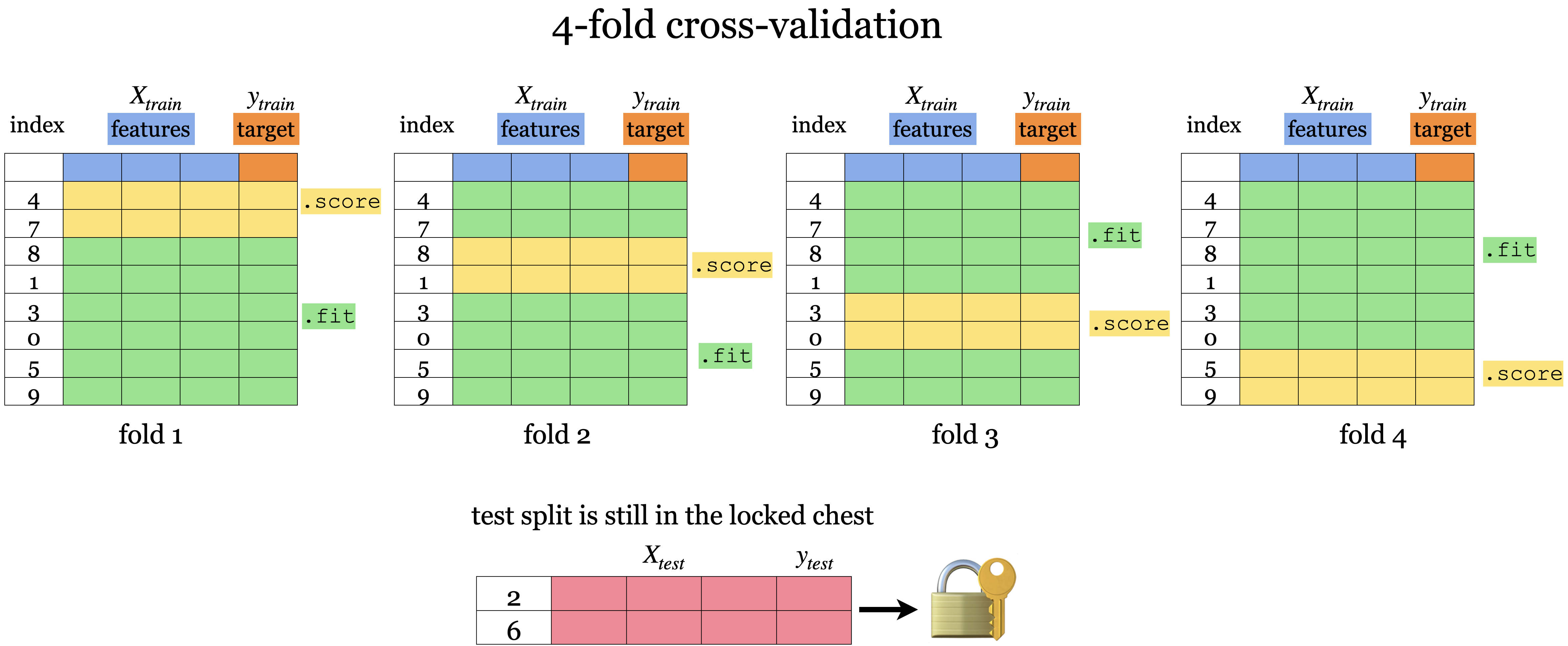
- \(k\)-fold cross-validation calls fit \(k\) times
- We use cross-validation to get a more robust estimate of model performance.
- If the mean train accuracy is much higher than the mean cross-validation accuracy it’s likely to be a case of overfitting.
- The fundamental tradeoff of ML states that as training error goes down, validation error goes up.
- A decision stump on a complicated classification problem is likely to underfit.
Recap from videos
- Why do we split the data? What are train/valid/test splits?
- What are the benefits of cross-validation?
- What is underfitting and overfitting?
- What’s the fundamental trade-off in supervised machine learning?
- What is the golden rule of machine learning?
Summary of train, validation, test, and deployment data
| Train |
✔️ |
✔️ |
✔️ |
| Validation |
|
✔️ |
✔️ |
| Test |
|
once |
once |
| Deployment |
|
|
✔️ |
Cross validation
![]()
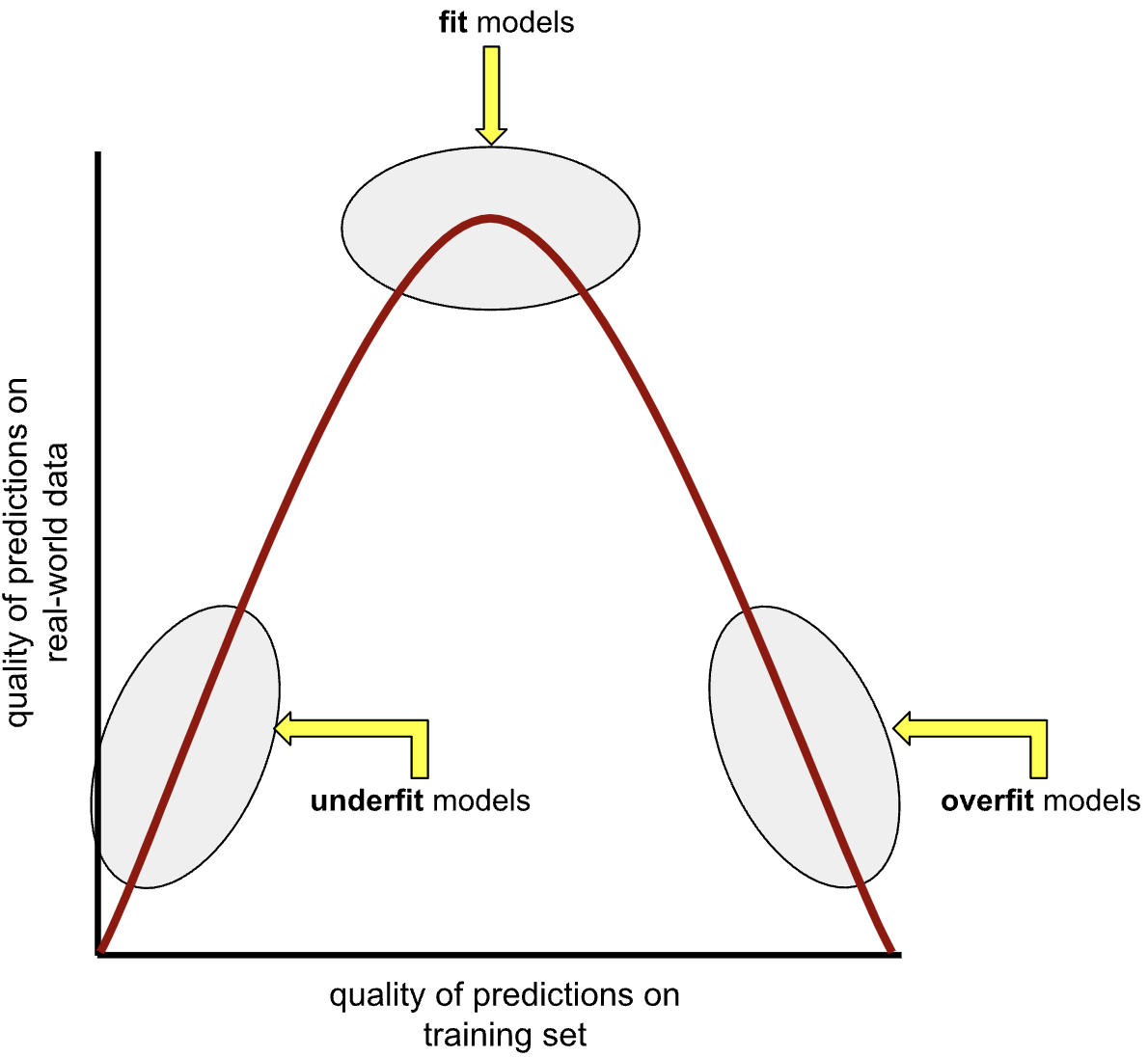
Overfitting and underfitting
- An overfit model matches the training set so closely that it fails to make correct predictions on new unseen data.
- An underfit model is too simple and does not even make good predictions on the training data
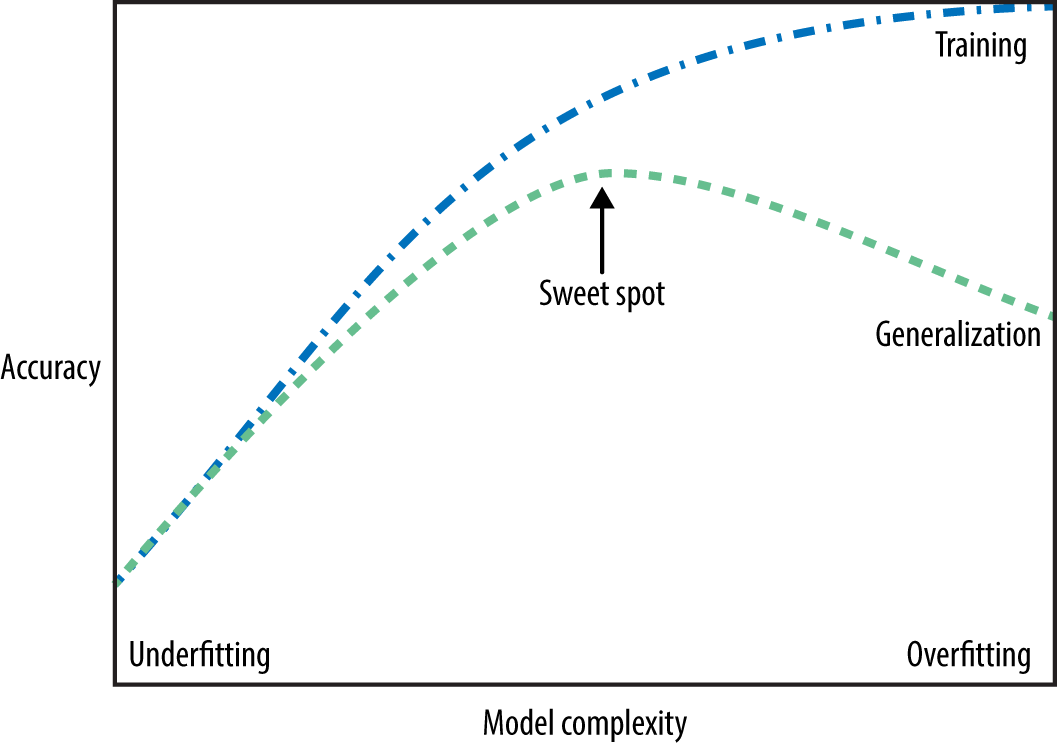
The fundamental tradeoff
As you increase the model complexity, training score tends to go up and the gap between train and validation scores tends to go up.
- Underfitting: Both accuracies rise
- Sweet spot: Validation accuracy peaks
- Overfitting: Training \(\uparrow\), Validation \(\downarrow\)
- Tradeoff: Balance complexity to avoid both
The golden rule
- Although our primary concern is the model’s performance on the test data, this data should not influence the training process in any way.
![]() Source: Image generated by ChatGPT 5
Source: Image generated by ChatGPT 5
- Test data = final exam
- You can practice all you want with training/validation data
- But never peek at the test set before evaluation
- Otherwise, it’s like sneaking answers before the exam \(\rightarrow\) not a real assessment of your learning.
Break
Let’s take a break!
![]()
Group Work: Class Demo & Live Coding
For this demo, each student should click this link to create a new repo in their accounts, then clone that repo locally to follow along with the demo from today.

 Source: Image generated by ChatGPT 5