Lecture 13: Feature Engineering and Selection
Clicker Question 14.0
Suppose you are working on a machine learning project. If you have to prioritize one of the following in your project which of the following would it be?
- The quality and size of the data
- Most recent deep neural network model
- Most recent optimization algorithm
Feature engineering motivation
Discussion question
- Suppose we want to predict whether a flight will arrive on time or be delayed. We have a dataset with the following information about flights:
- Departure Time
- Expected Duration of Flight (in minutes)
Upon analyzing the data, you notice a pattern: flights tend to be delayed more often during the evening rush hours. What feature could be valuable to add for this prediction task?
Motivating Feature Engineering
Questions:
- What are two possible ways we could “engineer” features?
- Think broadly and philosophically rather than an implementation…
Garbage in, garbage out.
- Model building is interesting. But in your machine learning projects, you’ll be spending more than half of your time on data preparation, feature engineering, and transformations.
- The quality of the data is important. Your model is only as good as your data.
Activity: Measuring quality of the data
- What are some properties of “good” or “bad” data?
- Along what possible dimensions could we “measure” goodness of data?
| Dimension | Good Data | Bad Data | metric to measure |
|---|---|---|---|
What is feature engineering?
Feature engineering is the process of transforming raw data into features that better represent the underlying problem to the predictive models, resulting in improved model accuracy on unseen data.
- Jason Brownlee
- Better features: more flexibility, higher score, we can get by with simple and more interpretable models.
- If your features, i.e., representation is bad, whatever fancier model you build is not going to help.
Some quotes on feature engineering
A quote by Pedro Domingos A Few Useful Things to Know About Machine Learning
… At the end of the day, some machine learning projects succeed and some fail. What makes the difference? Easily the most important factor is the features used.
Some quotes on feature engineering
A quote by Andrew Ng, Machine Learning and AI via Brain simulations
Coming up with features is difficult, time-consuming, requires expert knowledge. “Applied machine learning” is basically feature engineering.
Better features usually help more than a better model
- Good features would ideally:
- capture most important aspects of the problem
- allow learning with few examples
- generalize to new scenarios.
- There is a trade-off between simple and expressive features:
- With simple features overfitting risk is low, but scores might be low.
- With complicated features scores can be high, but so is overfitting risk.
The best features may be dependent on the model you use
- Examples:
- For counting-based methods like decision trees separate relevant groups of variable values
- Discretization makes sense
- For distance-based methods like KNN, we want different class labels to be “far”.
- Standardization
- For regression-based methods like linear regression, we want targets to have a linear dependency on features.
- For counting-based methods like decision trees separate relevant groups of variable values
Domain-specific transformations
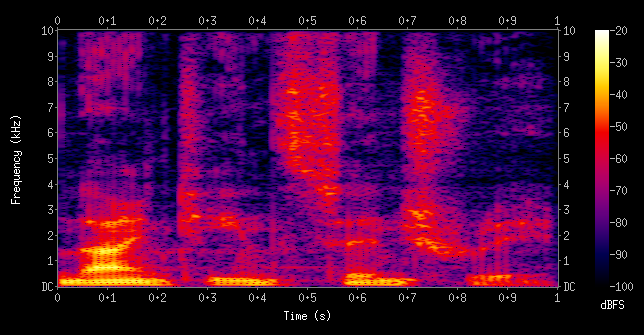
In some domains there are natural transformations to do:
- Spectrograms (sound data)
- Convolutions (image data)
Break
Let’s take a break!

Domain-specific transformations
In some domains there are natural transformations to do: - Spectrograms (sound data) - Wavelets (image data) - Convolutions
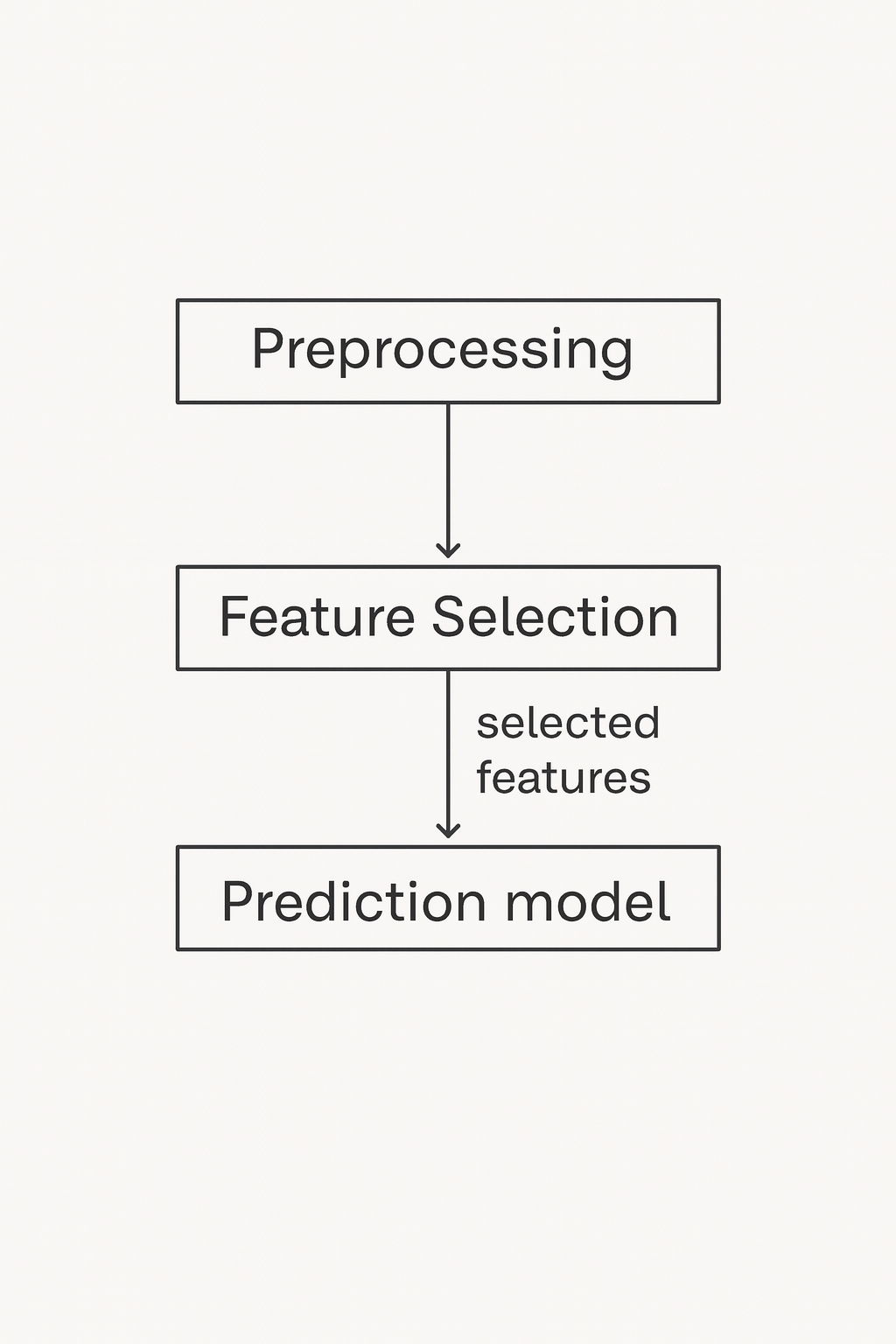
Feature selection pipeline
Two useful methods
- Model-based selection
- Use a supervised machine learning model to judge the importance of each feature.
- Keep only the most important once.
- Recursive feature elimination
- Build a series of models
- At each iteration, discard the least important feature according to the model.
Clicker Question 13.1
Select all of the following statements which are TRUE.
- Simple association-based feature selection approaches do not take into account the interaction between features.
- You can carry out feature selection using linear models by pruning the features which have very small weights (i.e., coefficients less than a threshold).
- The order of features removed given by
rfe.ranking_is the same as the order of original feature importances given by the model.
- The order of features removed given by
(iClicker) Exercise 13.2
Select all of the following statements which are TRUE.
- You can carry out feature selection using linear models by pruning the features which have very small weights (i.e., coefficients less than a threshold).
- The order of features removed given by
rfe.ranking_is the same as the order of original feature importances given by the model.
- The order of features removed given by
Group Work: Class Demo & Live Coding (if time permits)
For this demo, each student should click this link to create a new repo in their accounts, then clone that repo locally to follow along with the demo from today.